Ariadne 3.0: A new generation of learning
A new generation of learning
As of 26 November 2026: Ariadne 3.0 is in development. We are planning to launch in March 2027. This page shows what we are building for launch.
Introducing Ariadne 3.0, a personal tutor for every home.
Show Ariadne 3.0 a question, a photo of a worksheet, a PDF or a diagram, or simply ask her out loud. She explains things in your language, draws diagrams to show what she means and gives you a hint so you can try the next step yourself. A conversation can become flashcards, practice tests, study plans, documents or slides. Ariadne remembers what you already know, which explanation helped you understand it, what is coming up next and where it fits into your week.
We are planning to launch in March 2027, initially for students from grade 5 through to the German Abitur. You can join the waiting list for free.
An answer takes a moment. Understanding takes time.
One teacher can have a room full of children, each stuck at a different point. What happens when a teacher can give one child their full attention? A study published in 1984 found that the average student who received one-to-one tutoring outperformed 98% of students in a conventional class.1
Whether someone at home can explain physics or pay for tutoring often comes down to luck. In Germany, a child’s educational outcomes depend more heavily on family background than in other countries.3
One-to-one tutoring and classroom teaching
Bloom, 1984 · Where the average student placed
PISA: 15-year-olds in Germany
OECD · Mean scores from 2012 to 2025
AI for homework and studying
JIM study · Young people aged 12 to 19 who use AI
With AI, an answer is only a question away. A worked solution can leave you unsure which step you missed. It can even get in the way of learning. In a study involving nearly 1,000 students, one group practised with an unrestricted AI chat and another with a tutor that offered hints.2
Practising with AI and taking the exam afterwards
Bastani et al., PNAS, 2025 · Change relative to the control group
“Someone asking about fractions for the third time deserves the same patience as the first time.”
A tutor who knows you. For every home.
Ariadne 3.0 works the way good teachers do when they can sit down with one child. What matters is what you can do for yourself by the end of that conversation.
Learning more in less time
Kestin et al., Scientific Reports, 2025 · 194 physics students
Understands what you show her
Learning rarely starts with a neatly typed question. It starts with a crumpled worksheet, something written on the board, a PDF from the school portal or a quiet “I don’t get it.” Ariadne 3.0 can work with text, speech, photos, images, diagrams and PDFs.
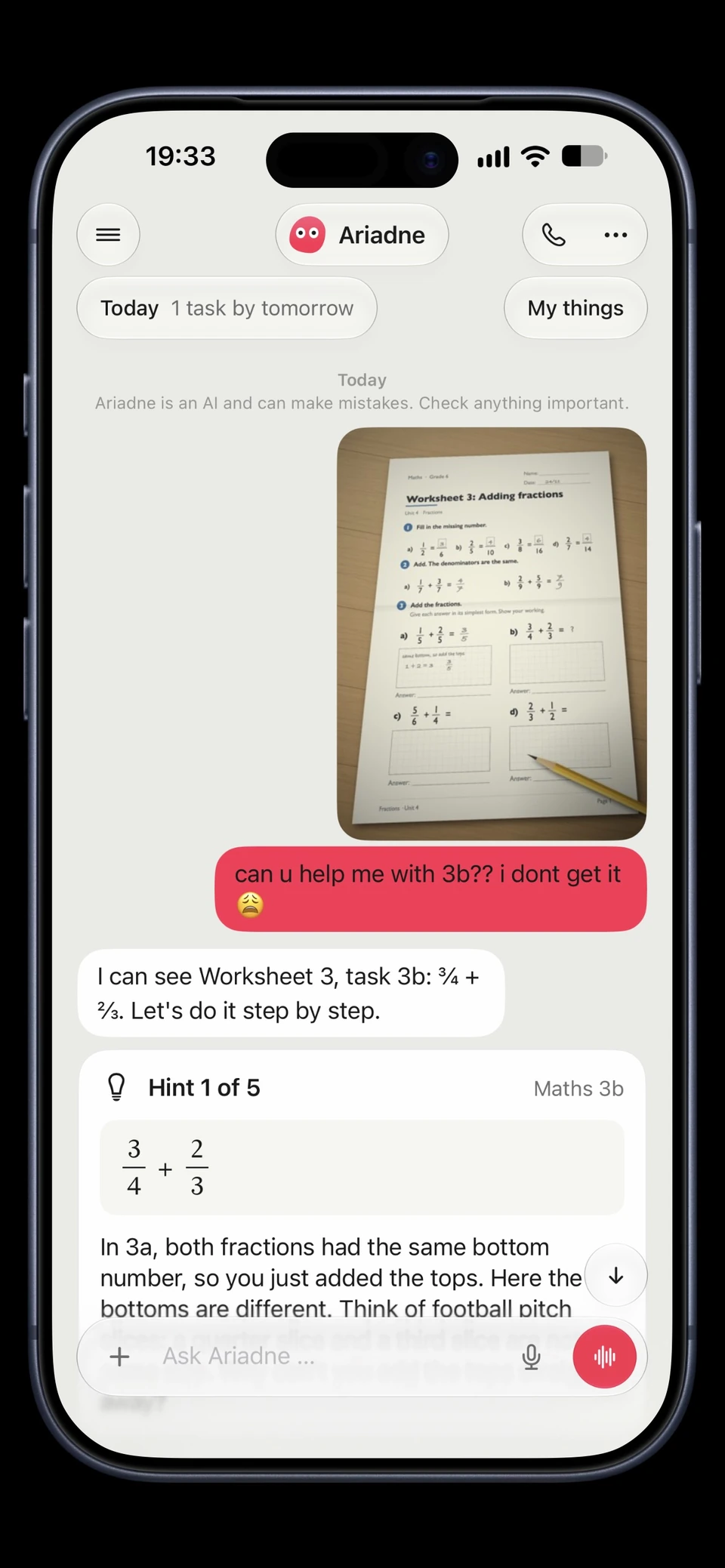
Show her a photo and she first tells you which exercise she can see. You can spot a misread number straight away.
Summarise Chapter 3 for me and quiz me on it.
Chapter 3 has three main ideas: light supplies the energy, water and carbon dioxide are the starting materials, and glucose and oxygen are produced. I’ve made eight flashcards. First question: what does the plant need light for?
Is the bike getting faster?
Look at the distances. After two seconds the bike has travelled ten metres. After four seconds it has travelled twenty. What does that tell you about its speed?
Shows you what she means
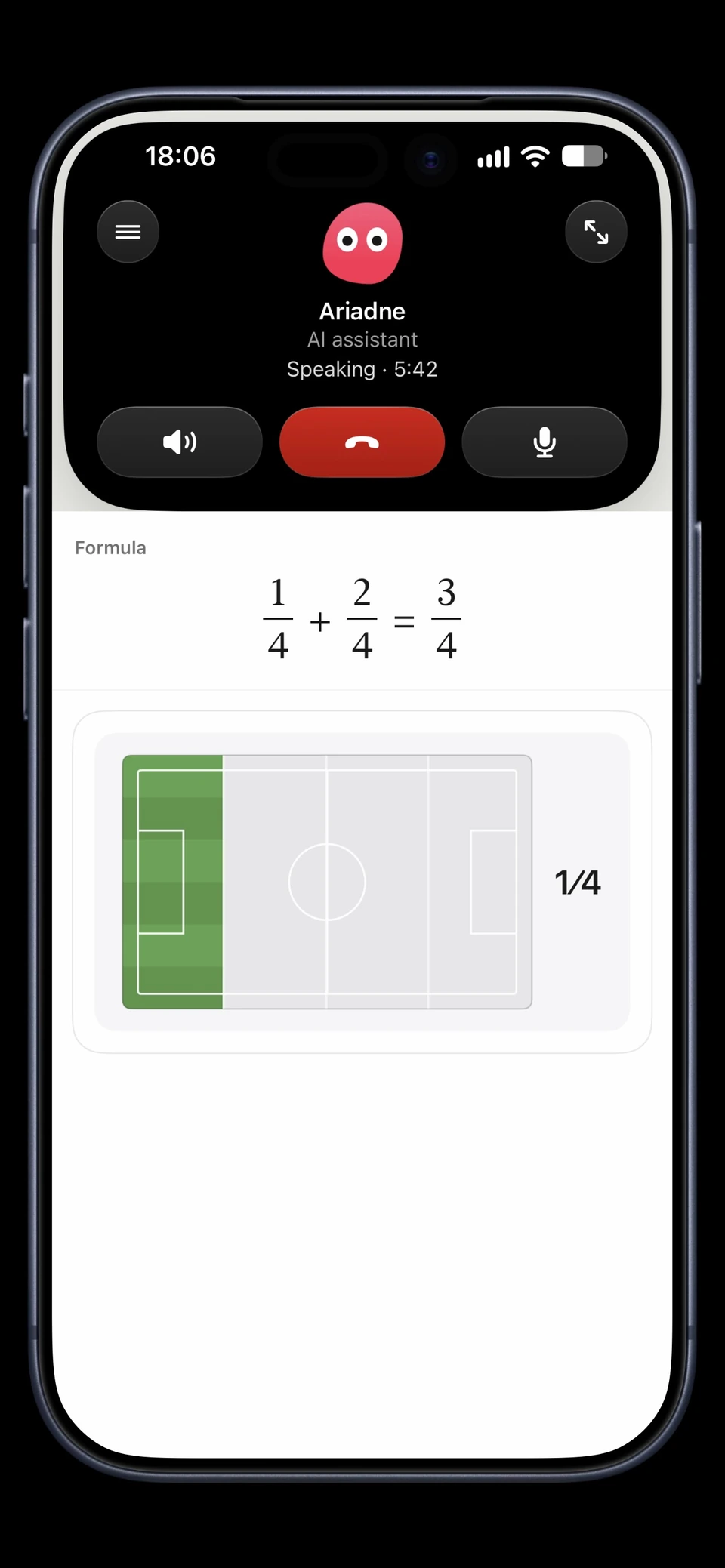
Some things click when you see them. Ariadne 3.0 draws her own explanations: fraction bars, number lines, charts, sketches or formulas that fit your question.
In a chat, the diagram appears in the reply. During a learning call, it takes shape as Ariadne speaks. You can follow the words and the picture together.
AriadneSpeaking
- Three quarters and two thirds. Look at the pieces. They’re different sizes.
- I’ll divide both strips into twelfths. Now the pieces are all the same size.
- Three quarters becomes nine twelfths. Two thirds becomes eight twelfths.
- Your turn. How many twelfths are there altogether?
Could you draw what goes into a plant and what comes out during photosynthesis?
Three things go into the leaf and two come out. Which of the three arrows brings in the energy?
Explains in your language
You can talk to Ariadne. Ask a question out loud and she answers, drawing what you are discussing on the screen. She also translates as you go. You hear the explanation in the language you think in best, alongside the German term you will need in class.
Nearly one in three schoolchildren in Germany has a history of migration in their family.6 In many families, German is not the language used to explain things at home.
You: Ähm… warum kann ich bei drei Viertel plus zwei Drittel nicht einfach oben und unten zusammenrechnen?
Ariadne: Gute Frage! Schau mal: Viertel und Drittel sind verschieden große Teile.
You: Okay… und jetzt?
Ariadne: Mach zuerst gleich große Teile daraus. Welche Zahl steht in der Vierer- und in der Dreierreihe?
You: Hmm, warte… zwölf?
Ariadne: Genau! Zwölf ist dein gemeinsamer Nenner.
You: Ah, okay. Also neun Zwölftel plus acht Zwölftel?
Ariadne: Ja, richtig. Den Rest schaffst du allein.
You: Şey… dörtte üç ile üçte ikiyi toplarken neden üstteki ve alttaki sayıları direkt toplayamıyorum?
Ariadne: Güzel soru! Bak: çeyrekler ve üçte birler farklı büyüklükte parçalar.
You: Tamam… peki şimdi?
Ariadne: Önce onları aynı büyüklükte parçalara çevir. Hangi sayı hem dördün hem de üçün katı?
You: Hmm, dur bir saniye… on iki?
Ariadne: Evet! On iki senin ortak paydan. Almancası: gemeinsamer Nenner.
You: Haa, tamam. Yani on ikide dokuz artı on ikide sekiz mi?
Ariadne: Aynen öyle. Gerisini kendin çözebilirsin.
You: اممم… في ثلاثة أرباع زائد ثلثين، لماذا لا أجمع الأعداد في الأعلى وفي الأسفل مباشرةً؟
Ariadne: سؤال جميل! انظر: الأرباع والأثلاث أجزاء مختلفة الحجم.
You: حسنًا… والآن؟
Ariadne: حوّلها أولًا إلى أجزاء متساوية الحجم. ما العدد الذي يقبل القسمة على أربعة وعلى ثلاثة؟
You: اممم، لحظة… اثنا عشر؟
Ariadne: بالضبط! اثنا عشر هو مقامك المشترك. وبالألمانية: gemeinsamer Nenner.
You: آه، فهمت. يعني تسعة على اثني عشر زائد ثمانية على اثني عشر؟
Ariadne: نعم، تمامًا. والباقي يمكنك حلّه بنفسك.
You: Емм… чому, коли я додаю три чверті й дві третини, не можна просто скласти верхні й нижні числа?
Ariadne: Гарне питання! Дивись: чверті й третини — це частини різного розміру.
You: Добре… і що тепер?
Ariadne: Спочатку зроби з них частини однакового розміру. Яке число ділиться і на чотири, і на три?
You: Хмм, зачекай… дванадцять?
Ariadne: Саме так! Дванадцять — твій спільний знаменник. Німецькою: gemeinsamer Nenner.
You: А, зрозуміло. Тобто дев’ять дванадцятих плюс вісім дванадцятих?
Ariadne: Так, правильно. Далі ти впораєшся самостійно.
You: Yyy… dlaczego przy trzech czwartych plus dwóch trzecich nie mogę po prostu dodać liczb na górze i na dole?
Ariadne: Dobre pytanie! Zobacz: ćwiartki i trzecie części mają różną wielkość.
You: Okej… i co teraz?
Ariadne: Najpierw zamień je na części tej samej wielkości. Jaka liczba dzieli się i przez cztery, i przez trzy?
You: Hmm, czekaj… dwanaście?
Ariadne: Dokładnie! Dwanaście to twój wspólny mianownik. Po niemiecku: gemeinsamer Nenner.
You: Aaa, okej. Czyli dziewięć dwunastych plus osiem dwunastych?
Ariadne: Tak, właśnie tak. Resztę policzysz już samodzielnie.
You: Um… why can’t I just add the numbers on top and on the bottom for three quarters plus two thirds?
Ariadne: Good question! Look: quarters and thirds are pieces of different sizes.
You: Okay… so what now?
Ariadne: First turn them into pieces of the same size. Which number is in both the four and the three times tables?
You: Hmm, wait… twelve?
Ariadne: Exactly! Twelve is your common denominator. In German: gemeinsamer Nenner.
You: Oh, okay. So nine twelfths plus eight twelfths?
Ariadne: Yes, that’s it. You can do the rest on your own.
You: Eh… ¿por qué no puedo sumar sin más los números de arriba y de abajo en tres cuartos más dos tercios?
Ariadne: ¡Buena pregunta! Mira: los cuartos y los tercios son partes de distinto tamaño.
You: Vale… ¿y ahora qué?
Ariadne: Primero conviértelos en partes del mismo tamaño. ¿Qué número está en la tabla del cuatro y en la del tres?
You: Mmm, espera… ¿doce?
Ariadne: ¡Exacto! Doce es tu denominador común. En alemán: gemeinsamer Nenner.
You: Ah, vale. Entonces, ¿nueve doceavos más ocho doceavos?
Ariadne: Sí, eso es. El resto ya lo puedes hacer por tu cuenta.
You: Euh… pourquoi je ne peux pas juste additionner les nombres du haut et du bas pour trois quarts plus deux tiers ?
Ariadne: Bonne question ! Regarde : les quarts et les tiers sont des parts de tailles différentes.
You: D’accord… et maintenant ?
Ariadne: Transforme-les d’abord en parts de même taille. Quel nombre est dans la table de quatre et dans celle de trois ?
You: Hmm, attends… douze ?
Ariadne: Exactement ! Douze est ton dénominateur commun. En allemand : gemeinsamer Nenner.
You: Ah, d’accord. Donc neuf douzièmes plus huit douzièmes ?
Ariadne: Oui, c’est ça. Le reste, tu peux le faire sans moi.
A learning call with Ariadne in your language. The German term stays on screen so you will recognise it in class. Illustration.11
A hint. Then your turn.
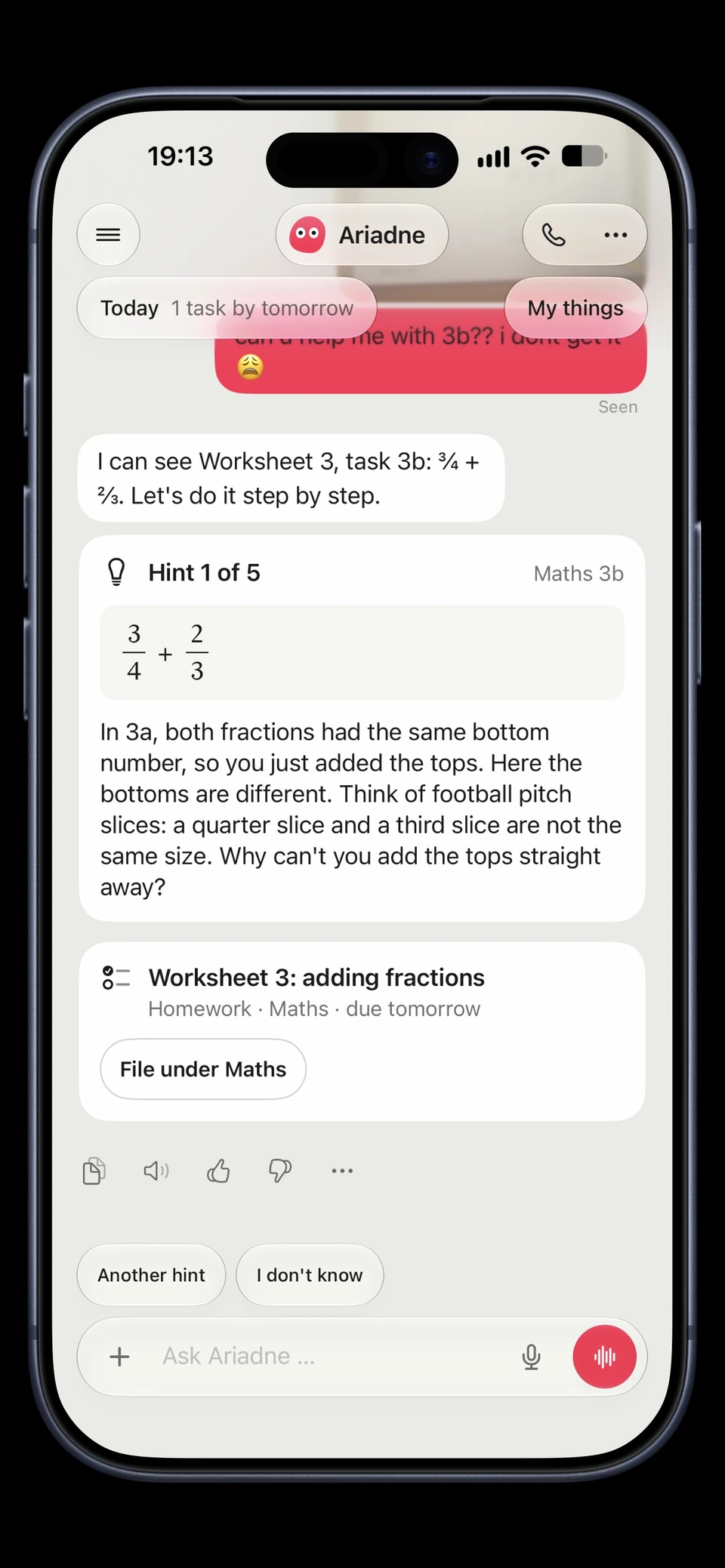
Ariadne 3.0 helps you work towards a solution. There are five levels of help, from a first question to a fully worked answer. Try the step yourself before moving to the next level. You can ask “Check my answer” at any point.
Worksheet 3b · ¾ + ⅔
I don’t know how to do this.
You’re adding two fractions. What do you notice about their denominators?
Worksheet 3b · ¾ + ⅔
I don’t know how to do this.
Quarters and thirds are different-sized pieces. You can add the pieces once they are the same size.
Worksheet 3b · ¾ + ⅔
I don’t know how to do this.
You can divide both into twelfths. ¾ is 9⁄12. How many twelfths is ⅔?
8⁄12?
Worksheet 3b · ¾ + ⅔
I don’t know how to do this.
Exactly. ⅔ is 8⁄12. Now you have 9⁄12 + 8⁄12. What does that give you?
17⁄12
Worksheet 3b · ¾ + ⅔
I don’t know how to do this.
That’s right: ¾ + ⅔ = 17⁄12. Now try ½ + ⅓ without a hint. Tell me why the pieces need to be the same size.
Each example ends with a new problem to try on your own. That is how you find out whether the idea has clicked. Illustration.11
Creates what you need to study
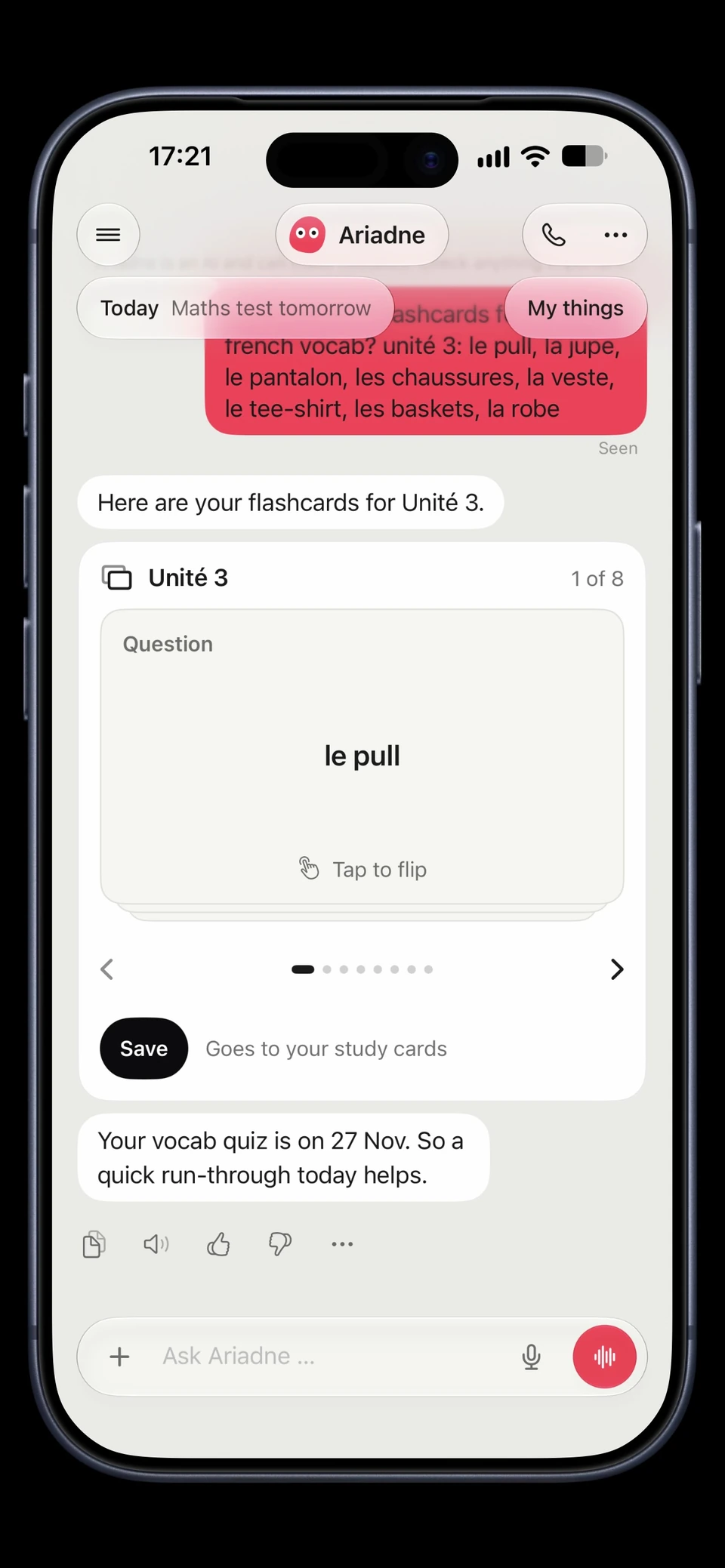
It is easy to lose a good explanation in a chat. Ariadne 3.0 can turn a conversation into flashcards, practice tests and study plans you can come back to. She can also put together summaries, revision notes and documents. If you have a presentation coming up, she can turn your outline into slides.
Speed
Distance divided by time: v = s / t. A straight line on a distance–time graph shows constant speed.
Acceleration
How quickly velocity changes: a = Δv / Δt.
Force
Newton’s second law: F = m · a. This was where you got stuck twice last week.
Knows your learning journey
A general AI chat knows what you have just typed. Ariadne knows what you can already do. She knows your timetable, your homework, the test on Friday and the topics that gave you trouble last week.
Your learning profile records what you understand about each topic. Covering something in class and being able to use it on your own are two different things. The profile belongs to you: you can view, change or delete any entry.
Adding fractions
- Status
- Still practising. Same denominators are going well. Different denominators need more practice.
- Last time
- Yesterday, worksheet 3b with two hints
- Next step
- Today: try ½ + ⅓ without a hint.
Tap a topic. This is the view Ariadne has of your learning, and you can see it too. Illustration with sample data.11
Remembers how you understood it
Ariadne remembers how you learned something: the explanation she gave, where you asked a follow-up and which example finally made sense. That goes for chats and learning calls alike.
When you start a new topic, she can begin with the kind of explanation that worked for you before. This history is part of your learning profile. You can view it, edit it or delete it.
Adding fractions: three explanations until it clicks
Explanation history from the learning profile · Sample data
An interface that adapts as you learn
Most AI chats answer every question in the same format: text. We built an interface for Ariadne 3.0 that lets her choose how and when to show a diagram, a hint card, a short quiz, a flashcard or a plan.
What you see depends on what you already know, which explanations work for you and what is coming up. Two people asking the same question can get different ways to explore it. Even for you, it can look different from one day to the next.
- This topic is new to you.
- Pictures have helped you more than rules recently.
- There’s time today. Nothing is due until Friday.
How do I add fractions?
Let’s start with a picture.
One quarter and two quarters. The pieces are the same size. How many quarters are there altogether?
- Your maths test is tomorrow at 8:00.
- You are comfortable with matching denominators. Different denominators still take practice.
- You have 20 minutes left today.
How do I add fractions?
You already know the rule. Let’s practise the step you’ll need tomorrow.
Tap an answer.
- You are asking about the same step for the third time.
- Last time, a playing field helped.
- You prefer to talk through tricky parts in a learning call.
How do I add fractions?
The playing field helped last time. Let’s use it again.
The field has four equal parts. One is marked. What fraction of the field is that?
One question, three times. What Ariadne shows depends on what she knows about how you learn. Illustration with sample data.11
Takes action for you. Shows what changed. Lets you undo it.
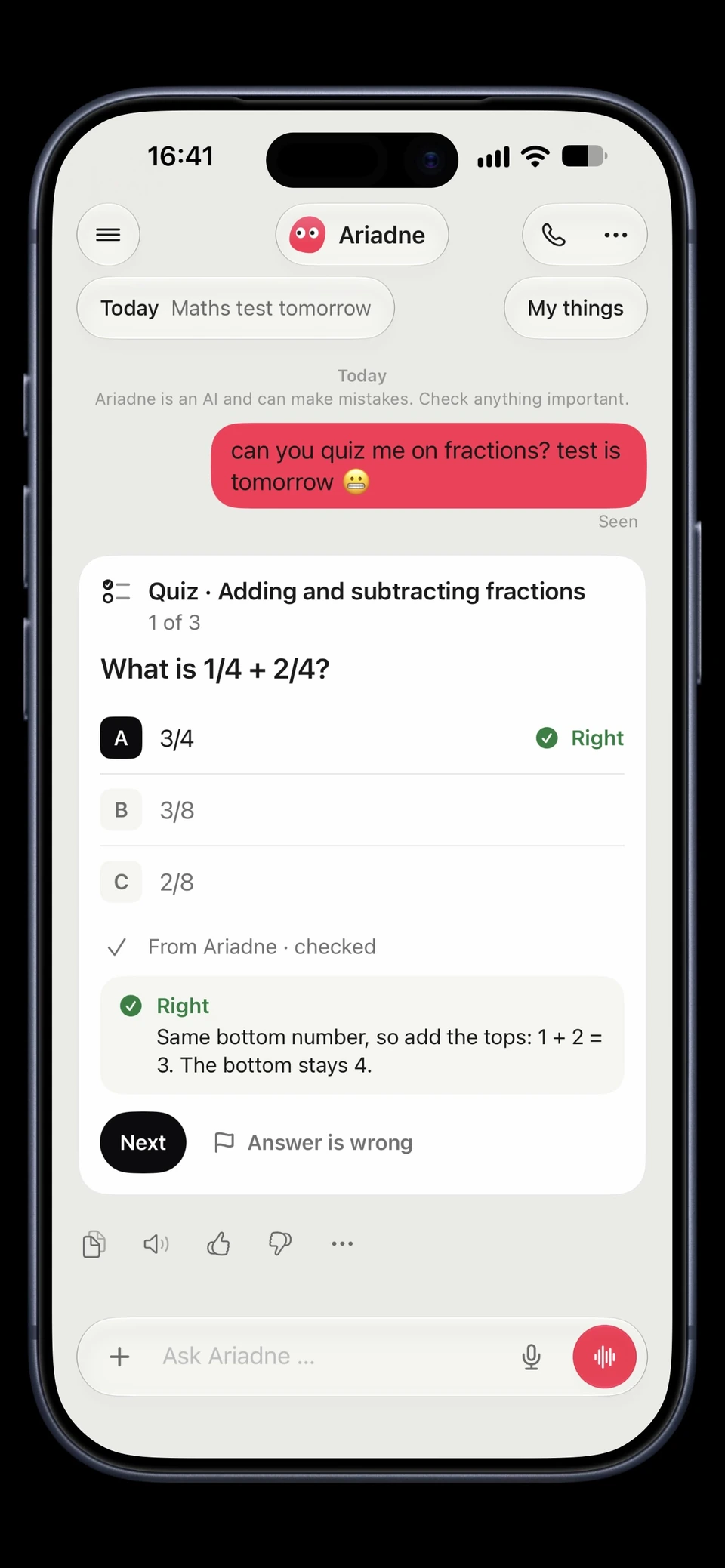
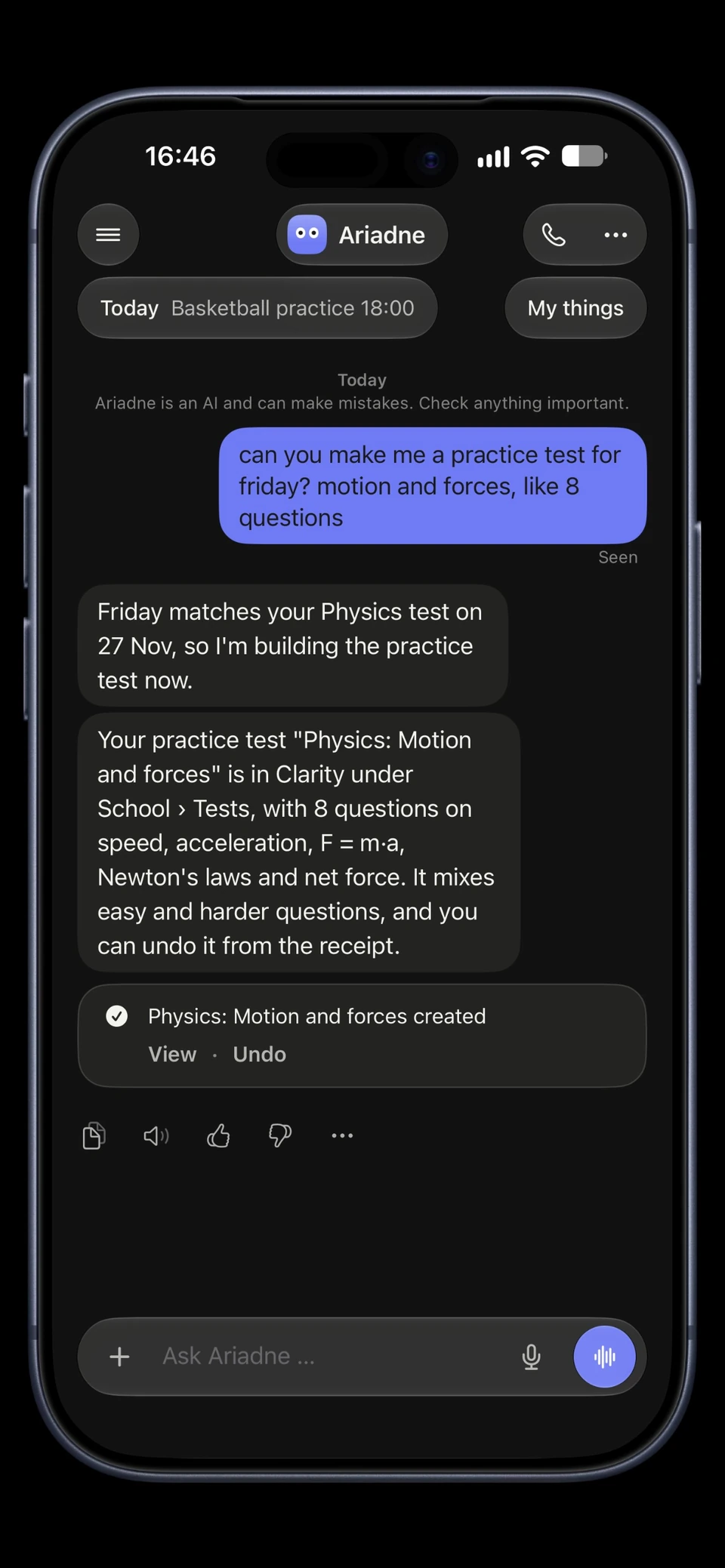
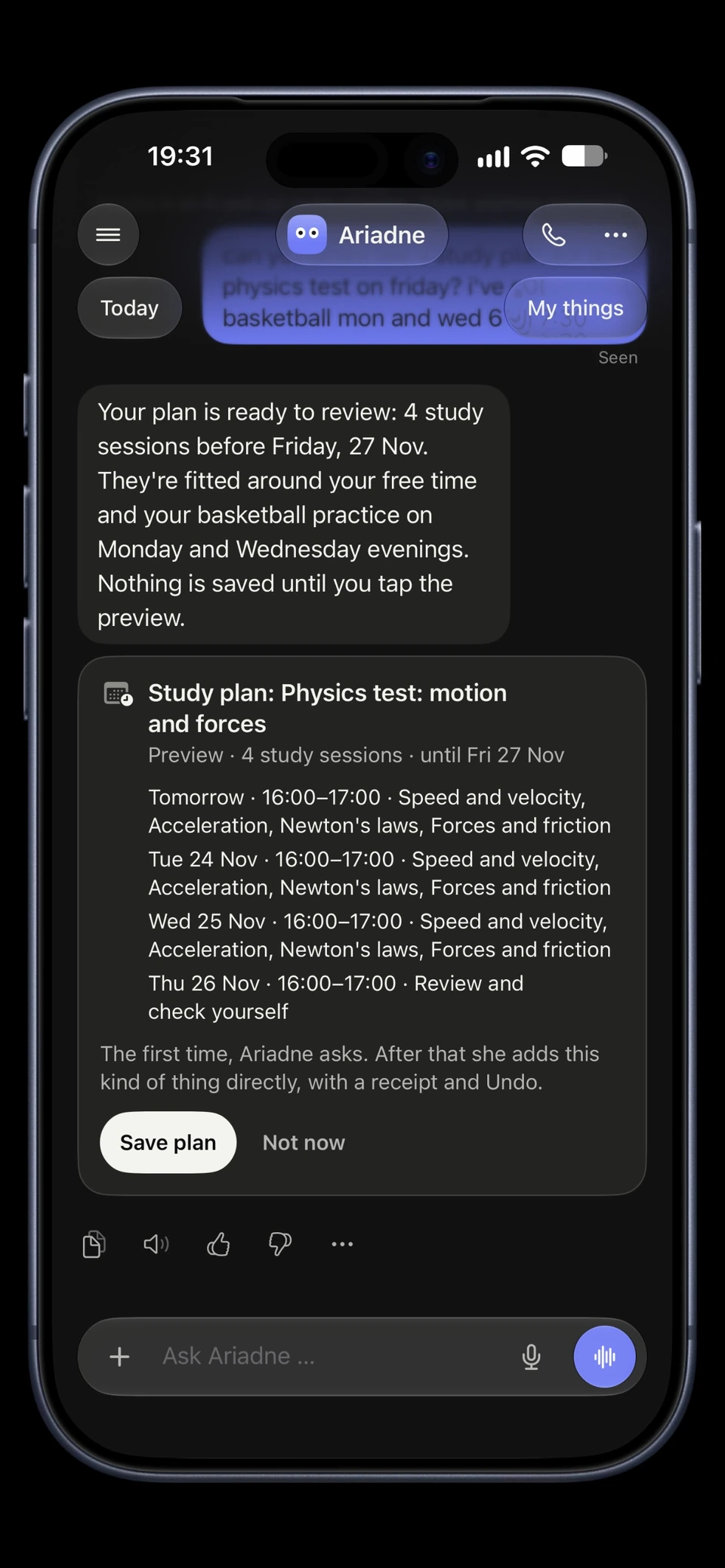
In Clarity, Ariadne 3.0 can create a practice test, suggest study times and remind you when to review. We are planning 48 tools across nine areas. You see each change as a preview beforehand or a confirmation afterwards, and you can undo it.
She can also check in when it helps, ahead of a test or a deadline. At most twice a day, outside lessons and quiet hours, with one concrete next step each time.
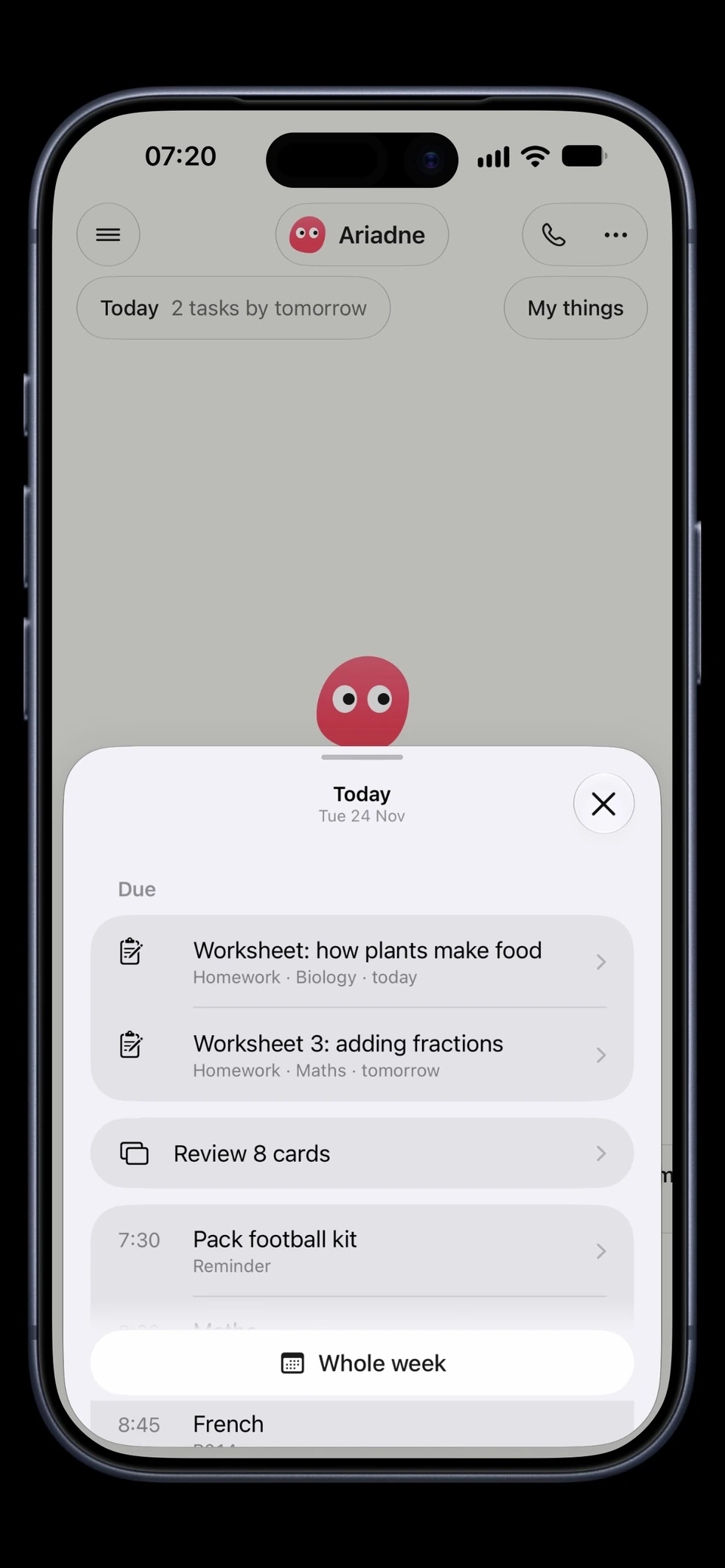
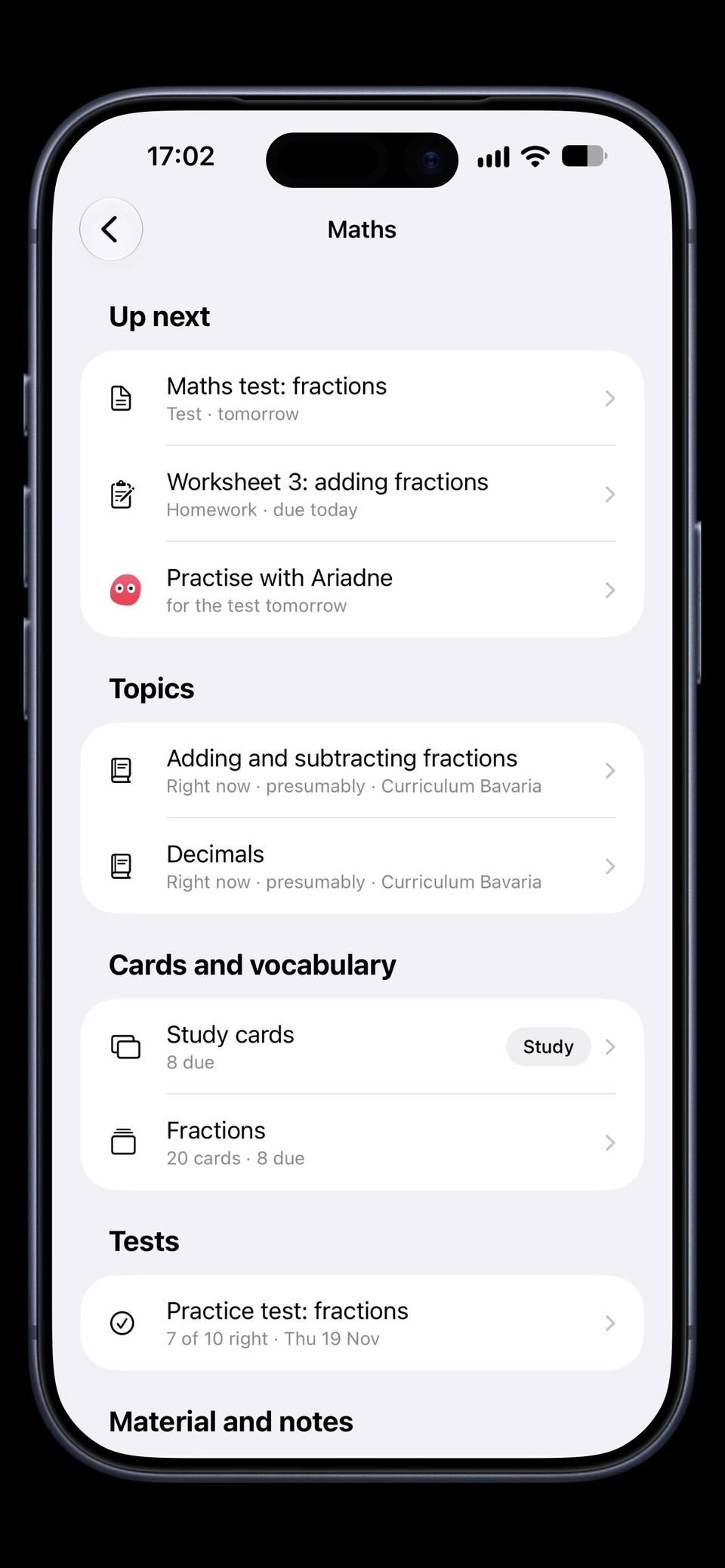
Today shows what is coming up and what can fit in between. Each subject brings its topics, flashcards and tests together.
One Ariadne. The look you choose.
Choose a look for Ariadne that feels right to you. Each character is a different appearance for the same assistant. Changing the colour has no effect on her abilities or your subscription.
For parents: stay involved while giving your child privacy
Questions do not always come up during a tutoring session. Ariadne is designed for the moment a child actually needs help. As a parent, you get a weekly view of the topics and dates your child chooses to share. Their conversations with Ariadne, photos, voice messages and personal learning journal stay private.
Maths · This week
Fictional example · shared by the child
- What the exercises show
- Comparing fractions is going well. Adding fractions with different denominators still needs practice.
- Shared date
- Maths test on Friday.
- A question for the dinner table
- Can you show me with a piece of paper why two quarters is the same as one half?
One year in comparison
Illustrative calculation · cumulative cost in euros
Space for feedback from a real student taking part in testing, with their permission.
Space for feedback from a real parent, with their permission.
Personal learning support should be a fundamental right.
The printing press multiplied knowledge. The internet shared it. Now it is time to make it personal. We want learning support to be as readily available as light: in every home, for every person, when they need it.
How do you build an education for eight billion people? You start with one.
The world faces a shortage of around 44 million teachers by 2030.7 No school system can give every child a teacher of their own. But every child can have someone who is patient, remembers what helped last time and takes their next question seriously.
We start with one person. With you and the task in front of you today. Then Ariadne grows with you.
Why now
There is a need. Around 11.5 million young people attend school in Germany.8 As early as 2016, 1.2 million of them were receiving tutoring. Parents spent €879 million a year on it.9
The habit is already there. 84% of young people have used ChatGPT, most of them for school.4 They already ask AI for help. They often learn less from it than they think.
The technology is here. Language models can understand speech, pictures and documents. What has been missing is a tutor that brings them together into a learning journey and safeguards the child.
Students in Germany
German Federal Statistical Office · 2025/26 school year
Tutoring in Germany
Bertelsmann Stiftung · 2016 parent survey
- Students receiving tutoring
- 1.2m
- Share of 6- to 16-year-olds
- 14%
- Parents’ annual spending
- €879m
- Average monthly cost per child
- €87
Young people who have used ChatGPT
JIM study · 12- to 19-year-olds in Germany
Building Ariadne responsibly for young people
A tutor for children and teenagers needs clear boundaries. These are the rules we are designing for Ariadne 3.0.
- 01You try first. The full solution comes afterwards.
- 02At most two prompts a day. Never during lessons or quiet hours.
- 03You can see, change or remove what Ariadne records about your learning.
- 04Your child chooses what parents can see and can pause sharing at any time.
- 05Changes to dates and learning materials come with a preview, a confirmation or an option to undo them.
- 06To make a Voice Note, record a short summary in your own words after class. Lessons themselves are not recorded.
AI can make mistakes. Check important results against your own materials. A practice result can help you choose a next step. It is not a grade.12 Read more about Trust and responsibility.
Ariadne 3.0. Planned for March 2027.
We are starting with students from grade 5 through to the German Abitur and their families. The planned price is €20 a month or €200 a year. We will announce age requirements, supported devices and parent access before launch. The current Clarity app is already available for iPhone and iPad.
Joining the waiting list is free. It does not involve a purchase or a subscription.
Ariadne 3.0 at a glance
Each capability and its current status.11
What Ariadne understands
| Input | Example | Status |
|---|---|---|
| Text | A question, a thought or an attempt at an answer | In development |
| Speech | Ask a question, follow up and listen during a learning call | Product preview |
| Photos | A worksheet, a page of notes or a diagram on the board | Product preview |
| Images and diagrams | A chart, a sketch or a map | In development |
| PDFs and documents | A chapter from the school portal or a set of lecture notes | In development |
| Timetable | Photograph, check and confirm | Product preview |
What Ariadne creates
| Output | What you get | Status |
|---|---|---|
| Explanations | Step by step, with hints, in your language | In development |
| Flashcards | From your conversation, saved in your library | In development |
| Quizzes and practice tests | Questions on a topic, with feedback on each answer | In development |
| Study plans | Sessions that fit around appointments and hobbies | Demo with sample data |
| Summaries and revision notes | A document based on your own materials | In development |
| Presentations | Slides based on your outline | In development |
| Explanatory diagrams | Drawn by Ariadne in chat and live during a learning call | Product preview |
What Ariadne knows about your learning
| What Ariadne knows | What it is used for | Who decides |
|---|---|---|
| Your learning profile | Knowledge by topic, preferred explanations and study times | You can view, edit or delete it |
| How you came to understand it | The explanation you saw, where you asked questions and what helped | Part of your learning profile, which you can view, edit or delete |
| Timetable | What is coming up and when you have time | You confirm the import |
| Homework and tests | Choosing the next useful step | You enter or confirm the details |
| Flashcards and study materials | Reviewing what is due | You choose what to save and can undo it |
| Appointments and hobbies | Study times that fit your week | Only with your permission |
| Curriculum | Topics in context by federal state, school type and grade | You enter this once |
| Grades | Understanding where marks were lost | Separate permission, independent of other data |
What the interface shows
| Component | When Ariadne shows it | Where |
|---|---|---|
| Diagram | When a picture explains more than a sentence | In chat and live during a learning call |
| Hint card | When you are working on a problem | In chat |
| Quiz | When a test is coming up or you want to consolidate what you know | In chat |
| Flashcard | When it is time to revisit something | In chat and in your library |
| Study plan preview | When study time needs to fit around appointments | In chat, saved only when you confirm |
| Formula | When you are talking through a calculation | In chat and live during a learning call |
Three approaches compared
| AI chat without a study mode | Tutoring, one hour a week | Ariadne 3.0 | |
|---|---|---|---|
| Availability | Any time | At the agreed time | Any time |
| Knows your timetable, tests and learning progress | Only what you type in | What you tell your tutor | Yes, through Clarity |
| Offers a hint before the solution | No, answers straight away | Yes | Yes, with five levels of help |
| Turns conversations into learning materials | Text in the chat | Rarely | Flashcards, tests and plans in Clarity |
| Explains in your language | Yes | Usually in one language | Yes, with live translation |
| Shows what it is explaining | Mostly text | On paper | Diagrams in chat and live during a call |
| Remembers what helped you understand last time | Rarely | Yes | Yes, in your learning profile |
| Annual cost | Depends on the provider | €1,560 in this example10 | €240 planned |
| A person who knows you | No | Yes | No. Ariadne does not replace a person. |
Footnotes
- Bloom, B. S. (1984), The 2 Sigma Problem, Educational Researcher 13 (6). The average student receiving one-to-one tutoring scored about two standard deviations above the comparison class average.
- Bastani et al. (2025), Generative AI without guardrails can harm learning, PNAS. Nearly 1,000 students took part in maths lessons. Relative to a control group without AI, the changes were +48% and +127% during practice and −17% on the exam without AI. “Not significant” means that no difference was demonstrated. It does not mean exactly 0%. The researchers did not test Ariadne.
- OECD: PISA 2025 Results, Country Note: Germany, 8 September 2026. Mean scores for 2012, 2015, 2018, 2022 and 2025: maths 514, 506, 500, 475, 464. Reading 508, 509, 498, 480, 465. Science 524, 509, 503, 492, 486. Scores through 2022 are from the PISA reports for those years. Conversion into years of schooling follows KfW Research, 10 September 2026.
- Media Education Research Association Southwest (mpfs): JIM study 2024, 2025 and 2026, each surveying around 1,200 young people aged 12 to 19. AI for homework or studying is reported as a share of the young people who use AI.
- Kestin et al. (2025): AI tutoring outperforms in-class active learning. Scientific Reports 15. 194 students, two physics lessons. Median post-test scores were 4.5 for the AI tutor and 3.5 for classroom teaching, following a pre-test score of 2.75. The researchers did not test Ariadne.
- German Federal Statistical Office: 29% of students in general education schools had a history of migration in their family in 2024 (26% in 2019).
- UNESCO and the International Task Force on Teachers for Education 2030 (2024), Global Report on Teachers.
- German Federal Statistical Office: Press release no. 384 of 4 November 2026. In the 2025/26 school year, 8,998,200 students attended general education schools and 2,258,000 attended vocational schools.
- Bertelsmann Stiftung (2016): Private Tutoring in Germany. 14% of children aged 6 to 16, €879 million per year, an average of €87 per month.
- Illustrative calculation: Ariadne at €20 × 12 = €240 per year. Tutoring at €30 per 60-minute session, once a week for 52 weeks = €1,560. The example rate is not a measured market average. Holidays, cancellations and discounts are excluded.
- The product views show Clarity in development. Conversations and screens labelled “Illustration” show the intended learning experience rather than live responses from Ariadne. This page does not imply that individual features are generally available.
- Clarity has not yet conducted its own study on the effect of Ariadne on grades or learning outcomes.