Learn different. · Ada Lovelace · 1815–1852
Can you write music as instructions?
In 1843 Ada Lovelace imagined a machine that could also produce music. In Note A she set out a condition. The relationships between notes would have to be expressible as rules.
Your experiment
Two hands, paper, a pencil and three minutes
A dot means clap and a dash means rest. Each lasts one beat. Write four symbols and give the sequence to someone without clapping it first.
A question to take further
Do you hear the same rhythm? What rule would you add if you clap at different points?
Ada Lovelace · 1815–1852
She saw more than a calculating machine.
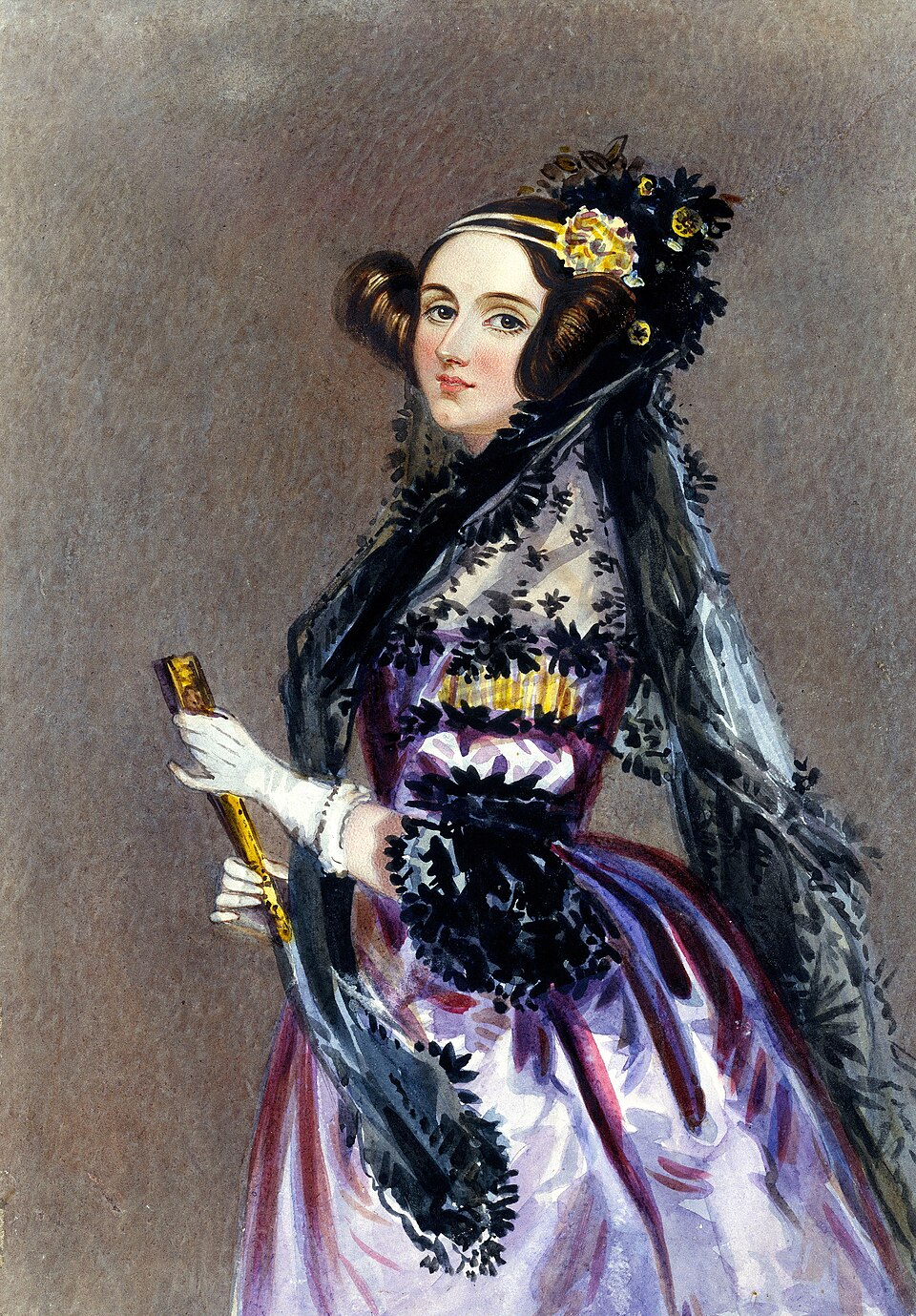
Ada Lovelace received intensive private education in mathematics at a time when this path was rarely open to women. Her teachers included Mary Somerville and Augustus De Morgan. She met Charles Babbage in 1833. She was seventeen when he showed her a working part of his calculating machine. This encounter grew into a long exchange about machines, mathematics and the possibilities they connected.
In 1843, Lovelace translated a French text by engineer Luigi Menabrea about Babbage’s planned Analytical Engine. She added extensive notes of her own. Among other things, she described steps for mathematical calculations that we would now call programs. The translation became an independent exploration: Lovelace explained the machine and developed its possibilities further. Her accompanying text eventually became much longer than the original paper.
Her vision extended far beyond numbers. Lovelace realised that other things could also be processed if their relationships could be represented formally, such as symbols or musical notes. The Analytical Engine remained a design during her lifetime. Her ideas therefore concerned a possible future. Today, they show how precision and imagination can come together when someone follows a familiar idea further.
- 1833
- Meeting Charles Babbage
- 1843
- Translation of Menabrea’s text with extensive notes of her own
- Beyond numbers
- Ideas about processing symbols and musical notes
Historical sources & image credit
- Science Museum Group: Ada Lovelace ↗
- Computer History Museum: Ada Lovelace ↗
- Computer History Museum: A Brief History of the Babbage Engines ↗
- Ada Lovelace, circa 1840, possibly by Alfred Edward Chalon. Science Museum Group / Wikimedia Commons. Public domain. ↗
- Portrait licence: Public Domain Mark 1.0; PD-Art / PD-old-100-expired ↗
The product views show Clarity Next in development. The Personal Tutor is planned for March 2027.
The learning approach in Clarity
A question.
Another approach.
Ariadne is being designed to move between text, images and voice. For the rhythm, she might ask you to change one symbol and describe the difference you hear in a sentence.


Other paths
A different question.
A fresh perspective.
Learn different.
Your question.
Your next step.
Register your interest in the personal tutor. Planned launch: March 2027.
No commitment. No purchase. We will notify you at launch.