At a glance
- When adding fractions, the first obstacle can be that the pieces have different sizes. A drawing can reveal where a learner is stuck.
- In a maths study, scores rose during AI-assisted practice. A later test without help produced a different result. That distinction informs our design for Ariadne.
The real question begins at the kitchen table
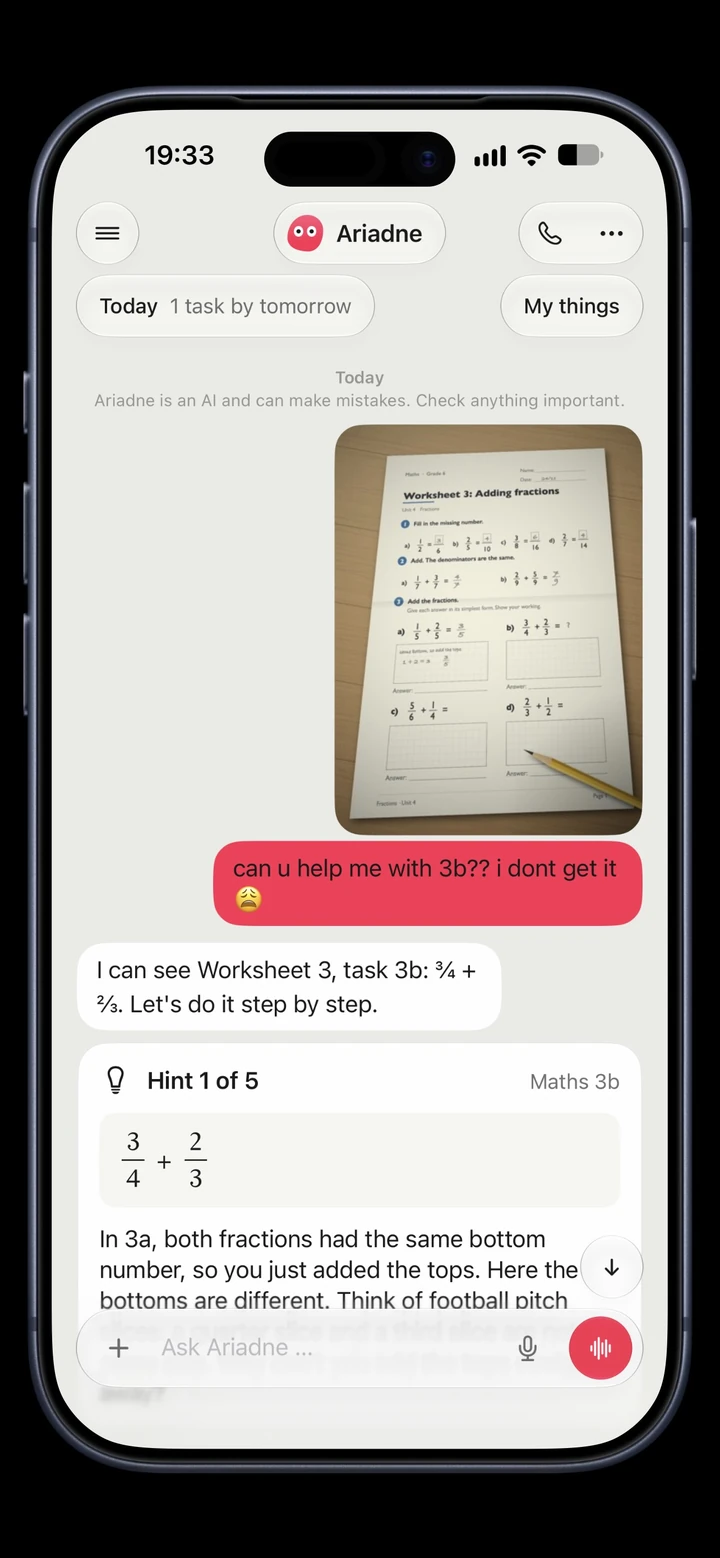
The page might say ¾ + ⅔. The learner can name both fractions, yet cannot move forward. A direct answer would finish the exercise. It would not reveal whether the different denominators, the unequal pieces or the first common step caused the difficulty. A useful conversation could therefore begin with a smaller question: Can you draw both fractions as parts of the same whole? If the drawing works, the next kind of help changes. If it does not, that is important information in itself. This is a proposed example of learning support, not a measured Clarity interaction.
A homework problem can stall on one small point: a term, a diagram or the first calculation. Clarity’s planned learning support therefore begins with the task and the learner’s own sticking point. A photo can help start the conversation; the learner must be able to check what was recognised.
A camera image can make text, numbers and diagrams available. It does not automatically know the classroom context: Which method has already been taught? Should the result be estimated, drawn or calculated formally? Was the handwriting recognised correctly? If the camera reads a minus sign as a fraction bar, the entire problem changes. The learner should be able to read and correct the recognised task before moving on. If a part remains unclear, a follow-up question is more honest than a confident solution built on a false reading. In Clarity’s product vision, the photo is an entry into a conversation, not an invisible shortcut to the answer.
Why less help can explain more
A hint is useful only if it aims at the point where the learner can try something independently. ‘Find a common denominator’ may be too large a step when the meaning of a denominator is still unclear. ‘How many equally sized parts would each whole have if you compared the two pictures?’ may be closer to the obstacle. The distinction cannot be inferred from a school year. It needs attention to the learner’s actual response and room for another question. The product goal is therefore not to make explanations endlessly longer, but to offer the smallest useful amount of help at the right moment.
A possible flow is short: read the task, propose an approach, receive a suitable hint and then continue independently. If an answer appears, the reasoning should remain open to inspection. The goal of support is for that support eventually to become unnecessary.
Four steps instead of a finished solution
| Step | Meaning |
|---|---|
| Task | What is given, what is being asked? |
| Own attempt | An initial thought, even if incomplete |
| Hint | Only enough help for the next step |
| Review | Explain the reasoning without help |
What the research actually shows
Bastani and colleagues separate two things that are easily confused in daily use: performance during AI-assisted practice and performance afterwards without AI. Both AI groups scored substantially better during assisted practice. In the unassisted exam, however, the unrestricted GPT group fell below the control group. The guided tutor avoided that negative effect but also produced no statistically demonstrated exam gain. The finding comes from a specific mathematics setting with specific tools and tasks. It is neither a universal verdict on AI nor a forecast for Clarity. It does establish a test standard: assistance must be followed by an independent assessment.
In a study with school students, generative AI helped during practice. Yet the group with unrestricted GPT access scored 17% lower than the control group on a later test without AI. A more guided tutor avoided that disadvantage but showed no demonstrated gain on that test. This argues for care in designing help; it is not evidence that Clarity is effective.
Performance relative to the control group
The second attempt is decisive
After a hint, a related but non-identical problem should follow. Someone who understood ¾ + ⅔ with support might then try ⅔ + ¼ without a visible worked solution. If that does not work, the remaining difficulty is more precise than before. If it does, the question is whether the same idea can still be recalled days later. Clarity aims to place such return points in a learning path. Whether a particular design really helps would need testing with no-AI tasks, suitable comparison groups and a delay. A green tick in the moment is not enough evidence.
A task can show parents or teachers where support is needed. A child’s whole reasoning process should not automatically become material for someone else’s assessment. A topic overview and a suggested next exercise, where permission allows, could be more appropriate. The pedagogical boundary matters too: when a task is tied to a classroom misunderstanding, a learner remains stuck repeatedly, or the system cannot justify an explanation reliably, human support must remain available. Personal AI support should make an independent attempt possible and recognise when it is not the right response to the problem.