At a glance
- What a learner can do on one task offers a starting point for the next question. A grade alone rarely reveals which step was difficult.
- In the planned learning profile, learners should be able to see what prompted a suggestion and correct a mistaken assumption.
The difference between a grade and a starting point
A maths grade compresses many situations into one number. It reveals little about whether fractions, word problems, time pressure or one missing foundation makes the next task difficult. A learning profile should not invent a more granular grade. It should describe a starting point for the next explanation: What did the learner demonstrate independently? Where was a hint needed? Which representation helped? The entry must be able to change when a new answer tells a different story. That ability to change is what separates a learning path from a label.
‘Good at maths’ or ‘bad at maths’ rarely explains the present difficulty. A useful learning profile would ask more precisely: Which task already works? Which intermediate step is uncertain? Which explanation made sense? Its purpose is to enable another attempt, not to fix a permanent judgement on a person.
Choosing a diagram for one fraction problem is an observed action. Inferring a permanent ‘visual learning type’ from it would be a much stronger claim. Clarity should avoid that leap. A useful entry might say: ‘In this problem, a drawing helped compare the denominators.’ It records context, timing and an observable effect within that particular exchange. It makes no permanent claim about the person. This distinction is essential for trust: learners should be able to see why a later recommendation appears and challenge an assumption that is wrong.
What can one correct answer tell us?
“Three of four equal parts are shaded.”
“It was the number in the last example.”
Feedback is personal only when it is actionable
The Education Endowment Foundation includes 155 eligible studies in its feedback review. It describes good feedback as information about performance in relation to a goal and about how to move forward. The evidence covers very different education approaches. It does not make an AI profile automatically effective. For our design, a profile entry should lead to a concrete action: solving a related problem without notes, explaining a term in one’s own words or revisiting an uncertainty. A colourful progress display without a next step would have little pedagogical value.
The Education Endowment Foundation describes feedback as information about performance in relation to a learning goal. Its review includes 155 studies and reports a positive average impact for the feedback approaches studied. This number evaluates neither Clarity nor an AI learning profile; it shows why feedback should be specific and actionable.
What a learning profile should show
| Step | Meaning |
|---|---|
| Topic | A specific goal rather than a blanket grade |
| Observation | What actually worked in a task |
| Next step | An independent attempt that can be checked |
Data can be wrong and must remain correctable
An automatically recognised task can be read incorrectly. A correct answer can be a guess. A wrong answer can reflect tiredness rather than a lack of understanding. A learning profile therefore needs provenance and uncertainty. Someone viewing an entry should be able to tell whether it came from a confirmed task, the learner’s own statement or a system suggestion. There also needs to be a simple way to delete or correct it. A profile that cannot be corrected becomes less personal with every mistake.
In Clarity’s vision, the profile connects topics, prior knowledge and new attempts. Someone who can split a fraction today may still need help adding fractions tomorrow. Good support recognises that difference, allows corrections and shows learners what information informs the next suggestion.
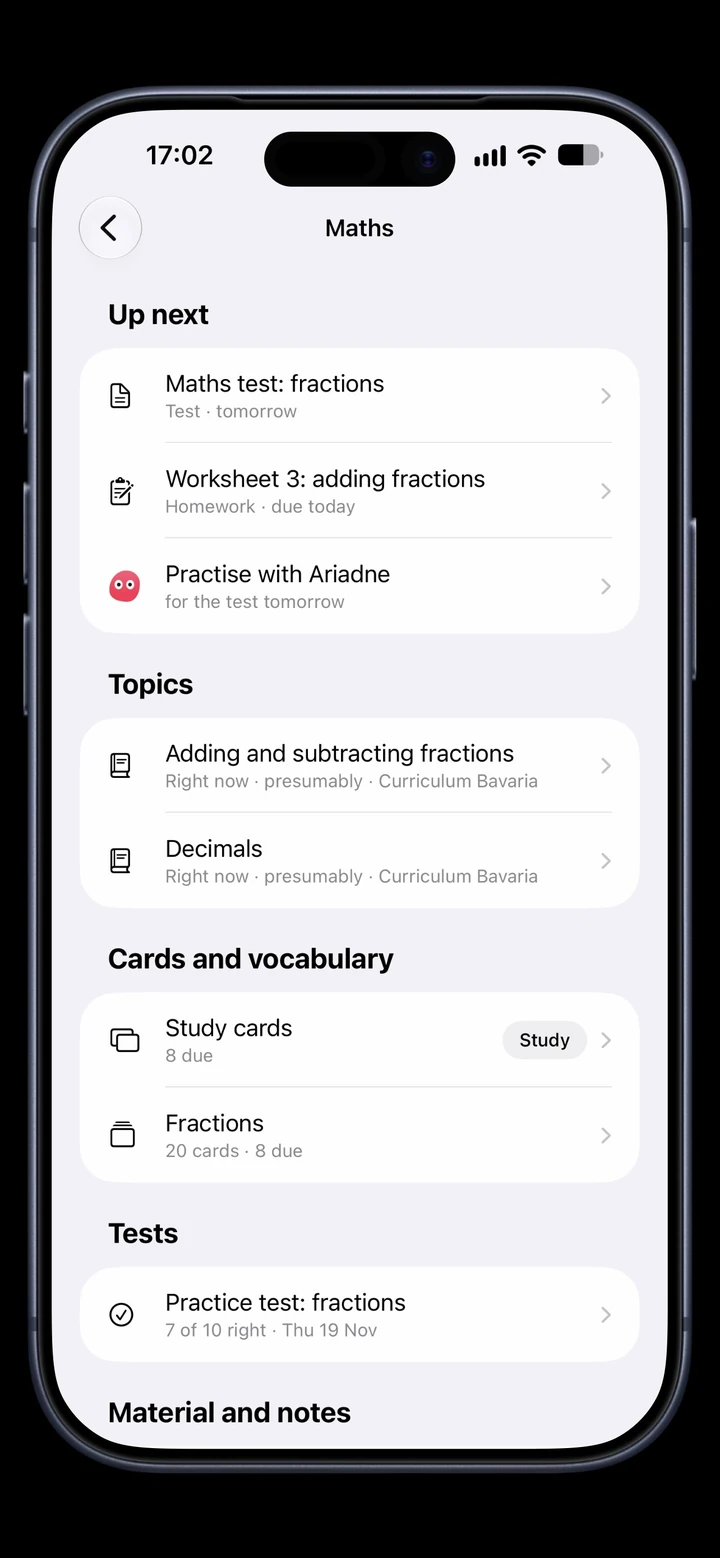
The learner helps decide what the goal is
For one person, Friday’s test matters most; for another, the first question is why a topic matters at all. A personal system should not silently replace these goals. It can suggest a next step and explain the basis for that suggestion. The learner can accept it, postpone it or name a different goal. This is more than a convenience feature: someone who understands and steers their learning path can take responsibility for it. The product’s role is to make good decisions easier, not to make them invisibly on the learner’s behalf.
A learning profile would not be good merely because it collects many data points. It would need to recommend better next tasks than a simple, transparent alternative. That requires tasks without system help, different subjects, learners with different starting points and evidence that children and parents understand the entries. Wrong recommendations and privacy costs also belong in the assessment. This article presents no such Clarity data. For now, it describes the direction of a product in development and the criteria by which it should later be judged.