At a glance
- A study session becomes more concrete when the learner knows which task they want to attempt without notes at the end.
- Research on spaced practice helps explain why it is useful to return to an idea. Classes, free time and rest also shape when that return fits.
Tuesday has a real length
A school timetable shows classes, not the whole afternoon. The journey home, sport, a conversation with friends and a break belong in the day as well. A study plan that treats these as interruptions may be ignored precisely when support is needed. Clarity’s concept therefore begins with the task ahead and the amount of time that really exists. A suggested twenty-minute session might be useful, but it is no universal rule. Some topics need longer; some days need no more screen time at all. Planning is a decision aid, not a machine for filling every available square.
School does not end when classes do. Homework, hobbies, family time and rest all share the same afternoon. A planned study block should therefore answer a concrete question: What is still unclear before a test? What can be tried today in a manageable session?
What distributed practice can offer
Cepeda and colleagues’ review contains 839 assessments drawn from 317 experiments in 184 articles. It examines the interval between study sessions and later recall of verbal material. One central point is that useful spacing is related to when the later test occurs. The number of experiments does not create a magic formula for every school subject. Clarity can draw a cautious product question from it: when is it worth revisiting a topic before it disappears from view? The actual decision must account for the learning goal, daily life and the learner’s response.
Cepeda and colleagues reviewed 317 experiments on distributed practice. The work mainly examined verbal recall. It supports spreading practice over time, but provides no universal timetable and did not test Clarity. The gap between sessions also depends on when knowledge will be needed again.
Half an hour, two possible weeks
- 10 minutes of practice
| Mon | Tue | Wed | Thu | Fri | |
|---|---|---|---|---|---|
| In one sitting | 30 min | 0 min | 0 min | 0 min | 0 min |
| Spaced out | 10 min | 0 min | 10 min | 0 min | 10 min |
An example that is allowed to change
A student has a test on Friday. On Monday, practice reveals an unclear term; on Wednesday, she solves a related problem without a worked example. A brief independent recall could be planned for Thursday. But if Wednesday disappears because of an important appointment, the plan should not turn into guilt. It needs a new priority. Perhaps one question on Thursday is enough; perhaps the teacher on Friday is the better person to ask. The table on this page illustrates one possible rhythm, not an individual recommendation or a result from user data.
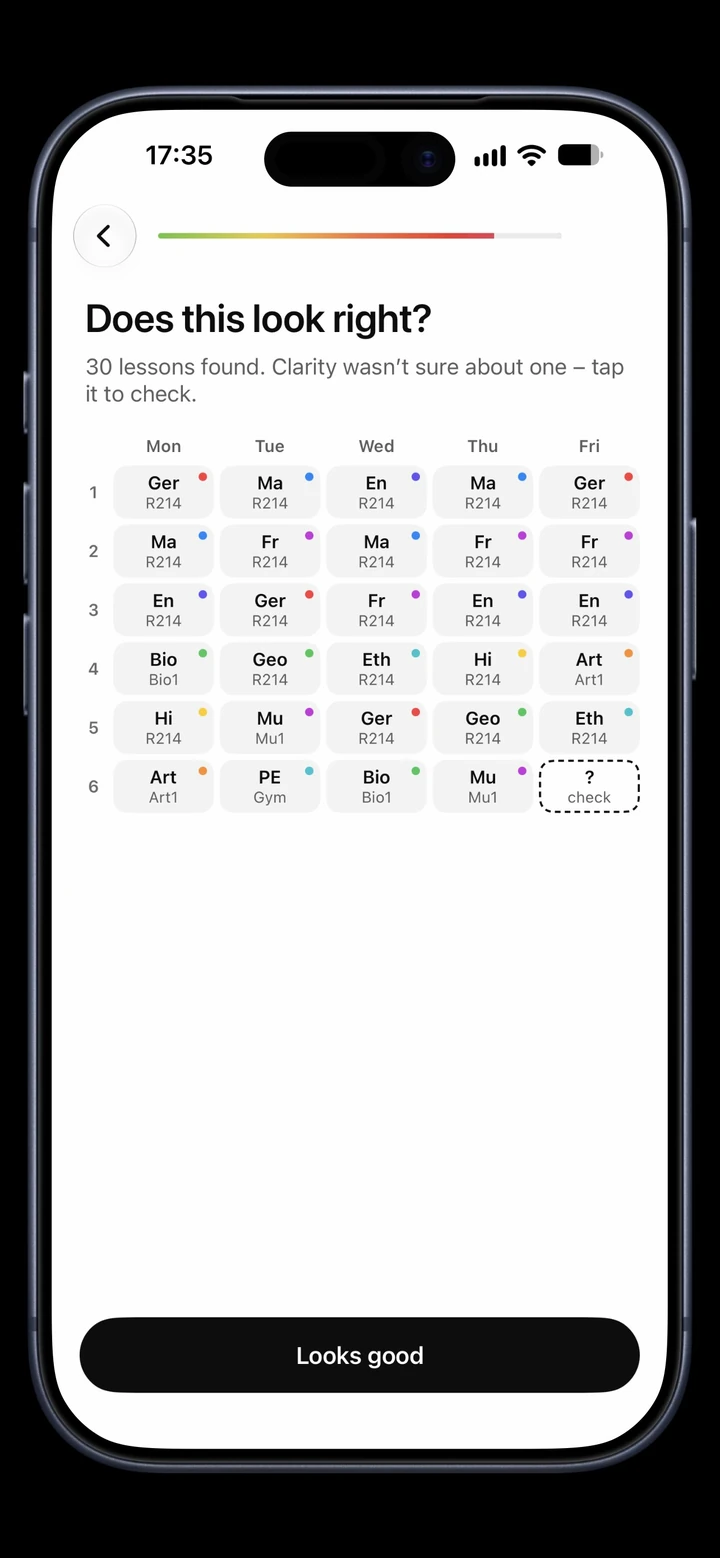
If an app recognises a photographed timetable, an uncertain image must not automatically become a binding appointment. The Clarity product page describes three stages: capture, inspect cells and consciously accept them. That order matters. A misread lesson could move a study suggestion to an impossible time. The person has to see, correct and confirm the entry. The same applies to tests and homework. A good plan shows not only what was suggested but also which details are confirmed and which still need a decision.
Rest is part of the decision
A digital planner can easily see free minutes as unused capacity. For learners, they are often recovery. Clarity should therefore not fill every gap or turn one missed session into an endless chain of make-up tasks. A useful question is: what is genuinely needed today to make progress tomorrow? The answer might be an exercise, a brief review, a conversation or a break. The product has to present these possibilities clearly and leave the decision to the learner. A plan’s quality shows in daily life, not in how densely it is packed.
Clarity is intended to use a timetable and upcoming tasks as context for suggestions. A recognised appointment must be checkable and confirmable. When a day fills up, a shorter independent attempt can be more useful than a plan that looks good on screen but fails in everyday life.
An illustrative rhythm, not a prescription
| Step | Meaning |
|---|---|
| Monday | See a new topic and note an open question |
| Wednesday | Repeat one step without notes |
| Friday | Check an independent solution before a test |
An attractive calendar does not prove that learning becomes easier. A serious evaluation would ask whether learners meet their goals, can recall topics later without help and find the plan relieving rather than burdensome. It would include different ages, school weeks with and without tests, and a comparison with simple self-made plans. Misclassified appointments would count too. This page presents no published efficacy study of Clarity’s particular planning feature. Research motivates an approach; it does not replace a test of that approach.